Coordinates
46°50’10″ N 9°16’52″ E 1102m ASL (Official landing field)
46°50’19″ N 9°17’08″ E 1112m ASL (Alternative landing field)
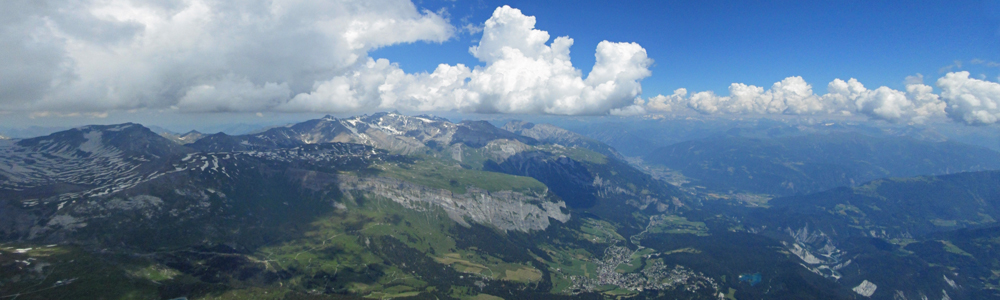
Flims is just over 100km from the Heimat takeoff, and although it is still 20km short of Chur, you may well appreciate its value as a useful landing option. The easterly breeze down in the valley is likely to have been strengthening as you progressed along the Surselva, but as the village lies 500m above the valley floor, you can expect to find much gentler aerology up here. Also, if föhn breaks through into the Surselva, Flims is less affected than the lower options. The village is easy to identify from the air, as it sits on a sunny plateau above the spectacular geological feature of the Rhine Gorge 5km to the south and below the massive rocky face of the Flimserstein to the north (as shown in the header image above, the view as you approach from the west). Be aware that the Flimserstein is a wildlife protection zone, which should not be overflown at less than 300m AGL.
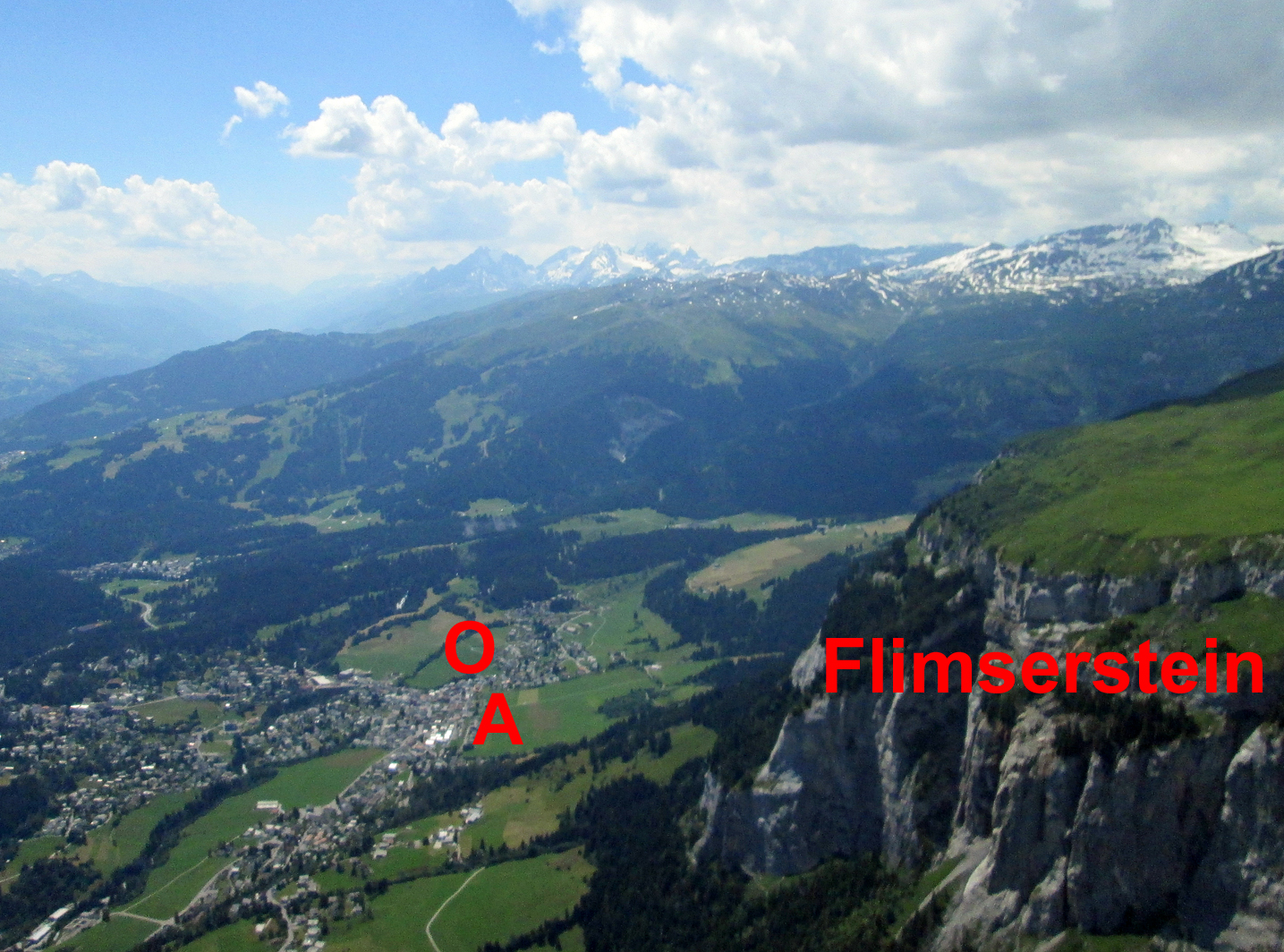
Flims, approaching from the east
Landing near Chur itself is inadvisable due to the likely presence of a vigorous north-easterly breeze at ground level there, which is to be expected even when there is a substantial meteo flow from the opposite direction. A safer option (unless you want to keep going to the east!) is to turn around once you’ve reached the Calanda (the mountain overlooking the city from the north-west), and fly back to Flims; the picture above shows the view from this direction. The extra 15km will not usually present a significant challenge unless there is a strong enough meteo flow from the south-west to overcome the usual valley breeze, as a glide of 10:1 would be sufficient to reach the village, and you would be unlucky not to pick up enough lift on the way to arrive here with plenty of height to spare.
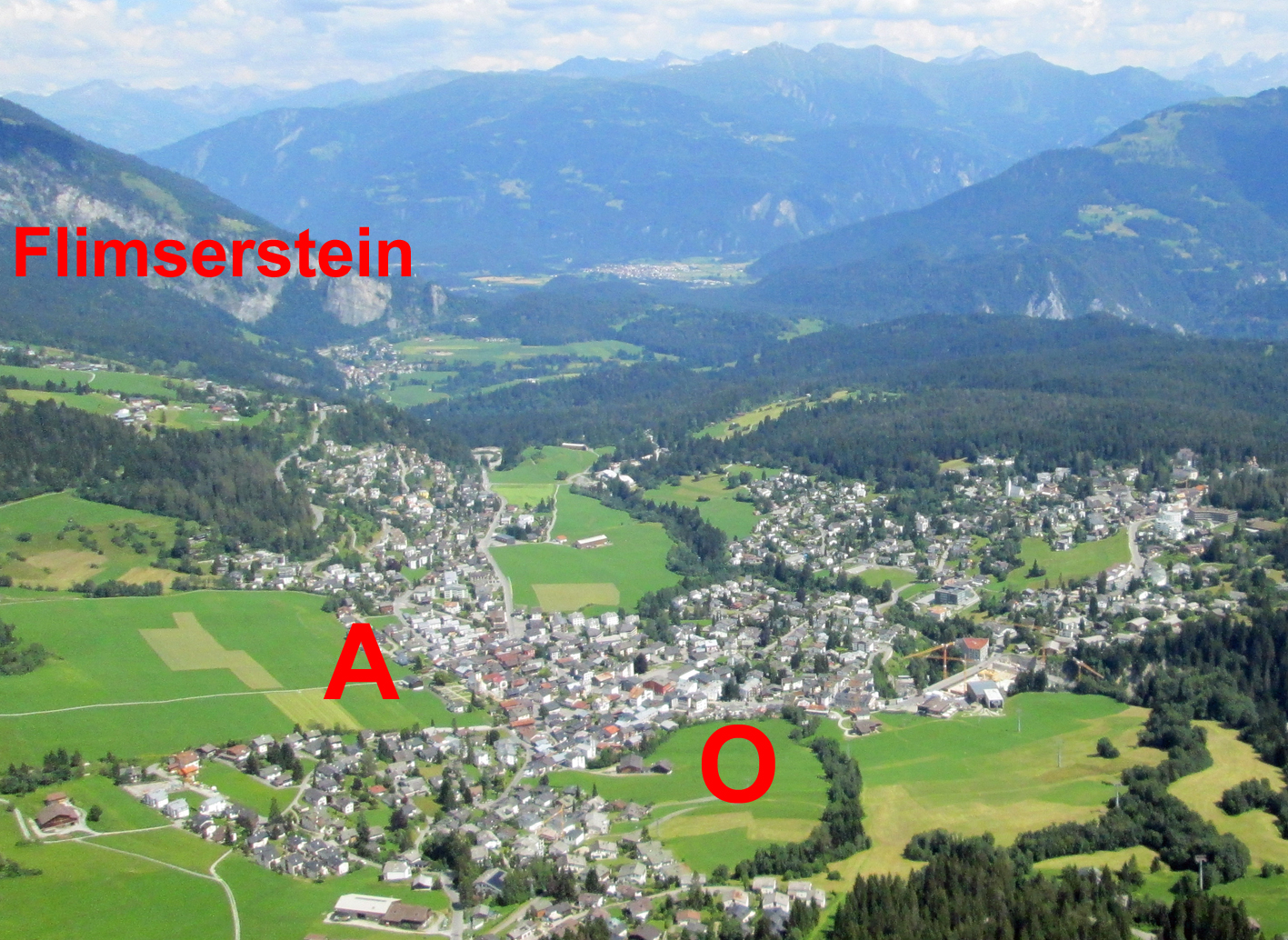
Flims, approaching from the west
There are two landing options, both on the north side of the village. The official landing zone, shown with an “O” in my images is open all year and has the benefit of a windsock, but can be a little awkward, in that it is surrounded by buildings or trees on three sides and slopes gently downwards to the east, away from the open side. I have only ever experienced light winds when landing here, and have sometimes been a bit concerned about the risk of overshooting in thermic conditions, but the area is large enough to allow paragliders to S turn to lose excess height if encountering unexpected lift on their final approach. The alternative landing zone, shown with an “A”, is a large open expanse, and much less susceptible to sudden changes in airflow close to the ground. However, it is closed in the spring and whenever it contains long grass, and you should only land here when you can see a windsock from the air (which indicates that it’s open); otherwise the official landing filed should be used. The packing area (see the local club website) is the western border of the field next to the road (not in the inviting shade of the church!).
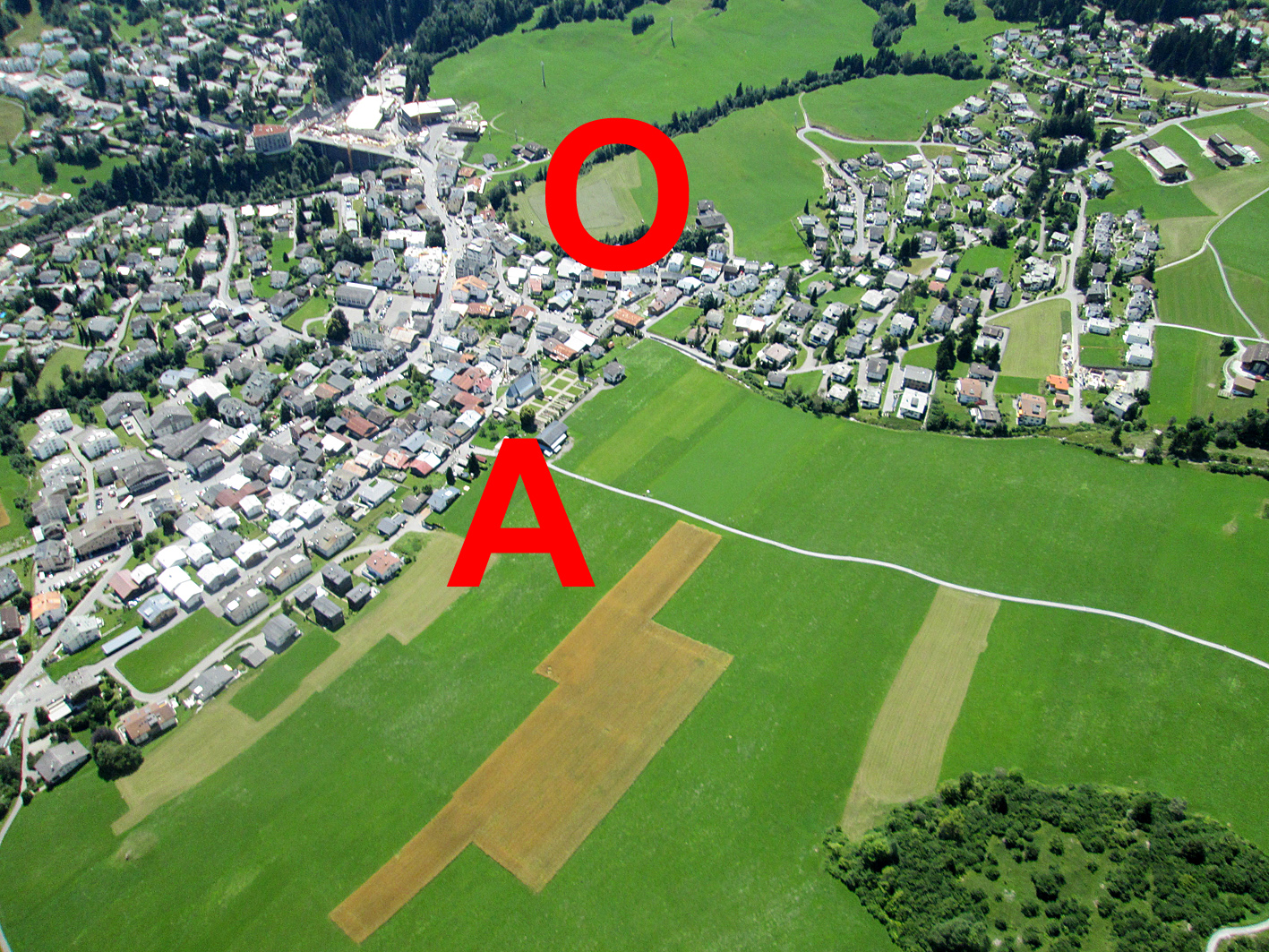
Flims LZs viewed from the north-east
A major disadvantage of landing at Flims is that it’s not on the rail network! The most direct route back to Fiesch involves getting two buses (or hitching) down to Ilanz, from where trains run every hour along the valley floor via Andermatt. The last bus from Flims to Ilanz to catch a train that arrives the same day departs at 17:25, and gets you back at 21:31. You have an extra half hour if you head in the opposite direction, towards Chur, with a deadline of 18:00, but the last same-day train from there goes via Zürich and Brig, doesn’t get in until nearly midnight, and is very expensive.
Therefore, unless you want to land at Flims due to safety concerns, e.g. föhn or overdevelopment, I recommend considering if you can fly down to the Castrisch landing field, 7.3km to the south-west and 400m lower. Simple arithmetic indicates that with a glide of 10:1, you can reach it if you have at least 330m of altitude in hand. Initially, the terrain is rather flat, but lower down the valley breeze from Chur is likely to provide some assistance in the form of a tailwind, and there are a few bombout options on the way if you encounter sink or can’t find the lift that you need, though some of these are rather tight.